I will hold the Christ-light for you
in the night-time of your fear
I will hold my hand out to you
speak the peace you long to hear
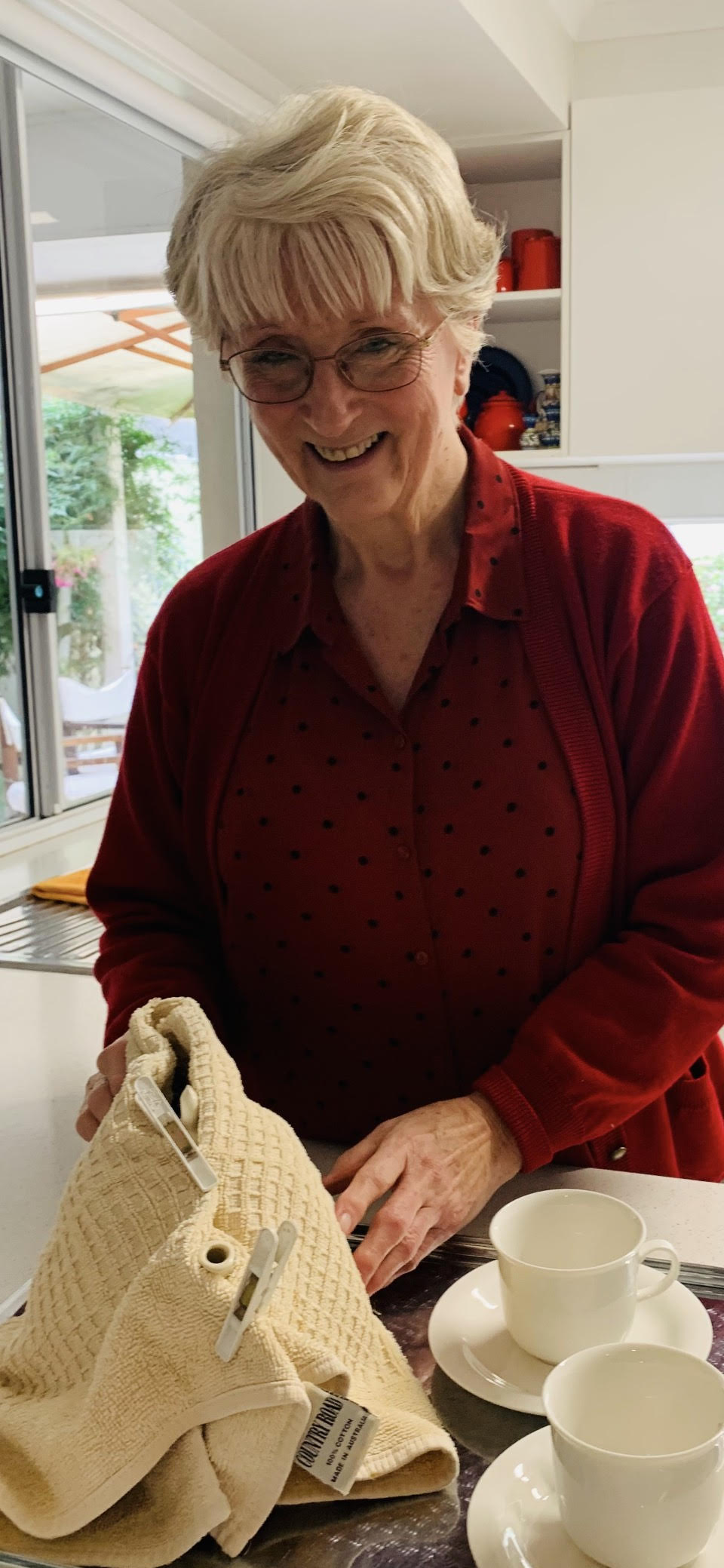
The second last time I saw Hilary she made me tea. She poured the hot water into an elegant white ceramic pot, selected two bone china teacups, and placed them on a tray. Then she suddenly darted into the laundry. She came out with an old hand-towel and two pegs, and proceeded to create the most ridiculous-looking tea-cosy I’d ever seen.
I laughed and she laughed at my laughing, and agreed to pose for a photo with her quizzical creation. I had no idea, at that time, that it would be the last photo I’d ever take of her.
It was funny because Hilary was the most tea-cosy-like person I knew. Her home was like an extension of her; beautiful, tasteful, comforting, sometimes surprising. It was a home that was comfortable with itself; modest, yet luxurious at the same time. She didn’t have clutter, although the house always felt full. A bowl of deep red cherries always sat temptingly on her white counter in front of the garden window. Bunches of super colourful flowers were everywhere; in her hallway, in the living room and through the house. It was some time before I realised she had found good quality plastic ones – which, of course, was easier than having to get them fresh all the time. Through long years of trial and error, she had discovered the best way to do things. Sometimes through a lot of patience and pain. And prayer, I suppose.
Hilary was the vicar at St James Anglican Church, Pakenham, when I arrived there as a fragile fifteen year old. In her 60s, she seemed like a harmless nice old lady to me when I first met her. She lilted away gently at her sermons in her sing-song Welsh accent. She delivered the liturgy with quietness and humility and grace. Yet she looked you straight in the eye when she handed you the wafer for communion and there was something in the way she said “the body of Christ, given for you” that made me feel like maybe it really was. My Dad says the day she won his respect was the time she led us in the Lord’s Prayer and then stopped, looked at us all and said “I just realised I said that without really meaning it. Do you mind if we all say it again?”
As I got to know her better, I learned that Hilary was a quiet radical. Someone who had worked long and hard to have her own house in order. Someone who actually believed what she said she believed. She became a female vicar in a time when women were discriminated against in church leadership. When she was appointed to St James, I was told that half the church left because she had suffered the pain of divorce in her personal life. She was an Anglican priest and yet she was primarily a woman who was in love with Jesus. She was drawn to where the Spirit of God was moving. About twenty years ago she travelled to Bethel and on missions in South America and encountered the power of the Holy Spirit to speak in tongues, to heal the sick, to cast out demons. She came back to St James to share the ways in which she had discovered God was bigger and more confusing than we’d previously known. And yet she didn’t push it on people. I remember her running optional ‘soaking sessions’ after the traditional services. I remember, as a teenager, watching curiously as the adults lay on the floor between the pews, basking in the transcendent presence of God, while the kids silently helped themselves to the church biscuits.
—-
I visited Hilary’s house many times over the years. In the last few years, I’d go every second Monday for lunch, and enter in to the smell of some keto casserole she’d been cooking for me. I would spend hours with her, crying and praying and drinking tea – nestled up in her warm lounge room or sitting outside on her patio. Her garden was strictly succulents – because they were easier to maintain. But she grew them somewhat obsessively, constantly propagating more in there greenhouse and frequently giving them away.
The garden was themed white and cream and green, with that one yellow flower that she couldn’t bear to get rid of. It felt calming and homely and beautiful all at the same time. And it was always clean. That was the thing that surprised me most – just how well she managed to keep everything. All of the colourful stone eggs in the bowl perfectly dusted, the cream tiles of her courtyard always swept, the eggshell-blue living-room carpets always fluffy. She was the kind of person who washed her windows – who laundered and dried her curtains every Spring.
This is why it was hilarious to me that Hilary didn’t have a tea-cosy, but instead used an old towel held together with pegs on her beautiful tea pot. “I will get you a tea cosy!” I declared, quietly resolving to knit her one for Christmas. After all, it would be a fitting, if small, token of the love I had for someone who had been a spiritual mother to me. On that day neither of us had any idea, as we picked up the tray and brought it out into her garden, that her body was fighting cancer, that she had just over six months to live.
—-
The last time I saw Hilary was just before my big operation. My cancer had grown back and they were going to cut out a key section of my bowel, leaving me with a permanent colostomy. I sat in her cream garden chairs and used up her tissues as I wept out my sorrow, my disappointment, my rage, my confusion with God, and my seeming inability to pray.
She sat there, with me, as she always did. I don’t remember much of what she said. I honestly don’t remember much of what she said over the many years and many hours of crying with her in this way. When I came back from Vietnam as an 18 year old who had lost faith in God. As a 24 year old who was unsure if I was going to be able to go ahead with my wedding. As a 32 year old who had just been told she could have months to live. What I remember is her presence, sitting with me in the pain, seeing me. Feeling my pain and yet not being overcome by it. Hilary had the amazing capacity and uncommon grace, as someone who had been through great pain, to re-enter it, with another – to hold onto them with one hand and to remain holding onto God with the other. When you are in that place, sometimes, you cannot reach out of it, but you can hold the hand of someone else who is willing to reach back in.
On that last day, which we didn’t know was the last day, she went into her study and came back with a wooden cross. “It’s OK” she said “that you cannot pray”. She had ministered to many people in the season of transition through death and she had a collection of these wooden crosses that felt smooth and comfortable in your hand. The wood, she said, came from olive trees from Jerusalem. The kind that could have been in Gethsemane. She invited me to choose a cross, anointed it with oil and prayed a blessing over it and over me. “When you cannot pray”, she said “hold this, and God will understand.”
Prayer suddenly felt possible again. I took it with me into the hospital. The nurses put it in a plastic bag so I could take it into theatre. It was sitting next to me on my bedside when I woke up in the ward.
___
As the days passed in hospital my body became strong again quickly. I regained the ability to get out of bed, to stand, and then to walk. I was doing surprisingly well and feeling a sense of optimism about being able to survive.
As I prepared to leave the ward to go home, I discovered the man in the room two doors down from me was being discharged also, but he was being sent home to die. With some reluctance but also conviction, I wrote a card and wedged the wooden cross uncomfortably inside the envelope, asking his daughter to deliver it to him if she felt it would be of any comfort. Hilary would approve of this, I figured. The hope of Christ was given to us to give away. And the next time I saw her, I’d ask her for another one.
What I didn’t realise was, at the time that my body was getting stronger and stronger, Hilary’s was beginning to give way. She waited to tell me because she knew it would hit me hard.
A few weeks after I got home from hospital, when she had already checked with Mum to be sure I was doing well, she called me to tell me that she had been diagnosed with cancer. She was at peace, she told me, and the Drs believed it was curable. I didn’t want to think about it. I couldn’t think about it. Instead, I kept recovering. I got busy. A few months passed and I texted her to say I was thinking of her, knowing that she would invite me to visit when she was well enough. She replied that her chemo was going well and would soon be finished. Life kept hurtling on. I was teaching again, as she had always believed that I would.
A couple of months later Mum and Dad were over for lunch. They told me she ‘wasn’t doing so well’. It took a week for me to push through the denial and text her about a catch up. A few days later, I got a response from her son saying it was too late.
And that’s how quickly it happened. That’s how quickly I lost one of the people who have had the most profound impact on my life. Tomorrow is her funeral.
I never knitted her the tea cosy. I was too focused on my own pain. I never asked for another cross. I was too focused on my own busyness. I never took the chance to say goodbye. I was too much in denial.
And yet, I am not wrecked with regret, with shame, or with despair. I have too many moments of experiencing grace. Somehow, the lightness that Hilary always brought to me in life is palpable even in the moments of her death – her faith and her hope linger on sweetly, even in her memory.
I am weeping, and I am in shock, and the loss is overwhelming. And yet, a candle flickers somewhere in the night-time of my heart. A peace has been spoken there that does not waver.
And I am grateful for Hilary -to have known her in this world, to be loved by her, and to love her still.
 Becoming Fully Alive