Today I went to the local hospital to get my blood taken in preparation for my cancer treatment on Thursday. This morning, slightly late as always, I panted down the corridor and noticed the nurse’s face light up as he saw me. As I wracked my memory for his face, he explained “I looked after you – it was nine months ago”. Somewhat bewildered, I followed him into the treatment rooms.
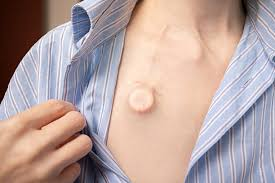
As I sat down in the chair, I started to guess why he had remembered me. I get bloods taken from my chemo port – a little coin-sized implant that sits below my right collar bone, connecting IVs directly into my jugular vein so that treatments can be pumped easily around my body. It’s a weird little device known mainly to cancer patients. My nurse looked down at me as he peeled back his shirt collar and pointed “I have one of these now too”.
“Oh shit!” I exclaimed, “I’m so sorry. When did you get the diagnosis?”
Its was four weeks ago. The poor guy who was tasked with taking my blood and flushing my port was absolutely reeling with the shock of having just been told he had a rare form of blood cancer and could join the ranks of the doomed. I could sense the first signs of grief from him; shock, disbelief, anger. It was almost as if he still needed confirmation from someone else that this was really happening, and he was seeking it at each moment his world started slipping away from him in a new way. He showed me his fingernails – somehow turned black from chemo. He pointed out his hair, which had started to turn white. His job, differently to mine, actually requires a lot of physical elements. He said it hurt him to extract the needle from my port, and his supervisor came in to help him trial it one-handed.
I could tell that it was shaking the other nurses in the department also. Confronting, perhaps, for them, who are so used to dealing with ‘cancer patients’ to find that one of their own – a fellow human, could so easily be relegated to that category. It doesn’t take two nurses to extract blood from a port, but I had three hovering around me for most of my appointment. Perhaps they were trying to discourage my nurse from getting too personal as he spoke with a patient. Perhaps they were simply wanting to do whatever they could to help him as he struggled through his new limitations. Either way, they sat around, subdued, listening, as I shared my story and tried to also hear some of his.
It was a strange moment, really, for the nurse who was treating me to open up, so vulnerably, and so incredibly needy. What he said with his words was nothing to what he said with his eyes. They were so lost, so panicked, so stricken with shock. I recognised the feeling.
It was a moment where I felt I had the opportunity to share some hope, some advice, to truly sympathise, to fight against the darkness of the prognosis and the suffering that is inadvertently inflicted by the system. I was able to share that I was told I would die years ago, that here I am alive and well, that I have learnt to hope and to fight against hopelessness. I told him I believe in God and that I believe in miracles. “So you are a miracle?”, he asked. I honestly don’t know if I think that is true. Maybe. But even if I’m not, and even if my good results do not continue, I do know that there is always hope.
“It’s so important to just stay positive”, the nurse at the computer said to me, “that’s what you’ve done”. But it’s not. It’s really not. ‘Just stay positive’ is honestly the most insipid, useless thing you can say to someone. I can’t tell you how many people I’ve had tell me that “you just have to stay positive”. I remember when I first got told I would die, a hairdresser told me “my girlfriend was amazing. She just stayed so positive, right up until the time she died”. I was like “Wow – do you realise what you’ve just said?”.
I don’t think it’s about ‘staying positive’. What’s the point of that? Is there some big ‘positivity rubric’ that cancer patients get marked upon? ‘C minus; you’re not taking the news of imminent suffering and death positively enough!’ I think it’s one of the stupidest things that people say.
But positivity is very different to hope. Hope is real. In fact, I believe that Hope is a person – and his name is Jesus. The person of Hope is someone who can hold us, when all else is gone. Hope can hold you when they tell you your cancer has spread. Hope can hold you when they say there’s nothing more they can do. Hope can even hold us through the transition commonly referred to as ‘death’. Hope and grief are not mutually exclusive states. In fact, that is when we most need Hope to wrap his arms around us.
Right now, in my life, Hope is holding me through yet another excruciating and complicated process of working through what my future holds – as the dreams of my heart and the realities of my situation and the injustices of a corrupt world collide, Hope is with me for the journey, whatever direction it goes.
And Hope, I pray, will come to my nurse from today also. I pray that he will continue to have good results in his body, as I have done, but even more that Hope will come and surround him with a knowledge that there is a force of LIFE, deeper than any cancer, deeper than the evil of this broken world, deeper even than death.
So, when your world falls apart, don’t try to “just stay positive”. Scream. Cry. Lament. Flail about, if you need to, in rage and in panic and in disbelief.
And then, crawl back again into the arms of the One who is Hope – a Hope strong enough to hold us through it all.